
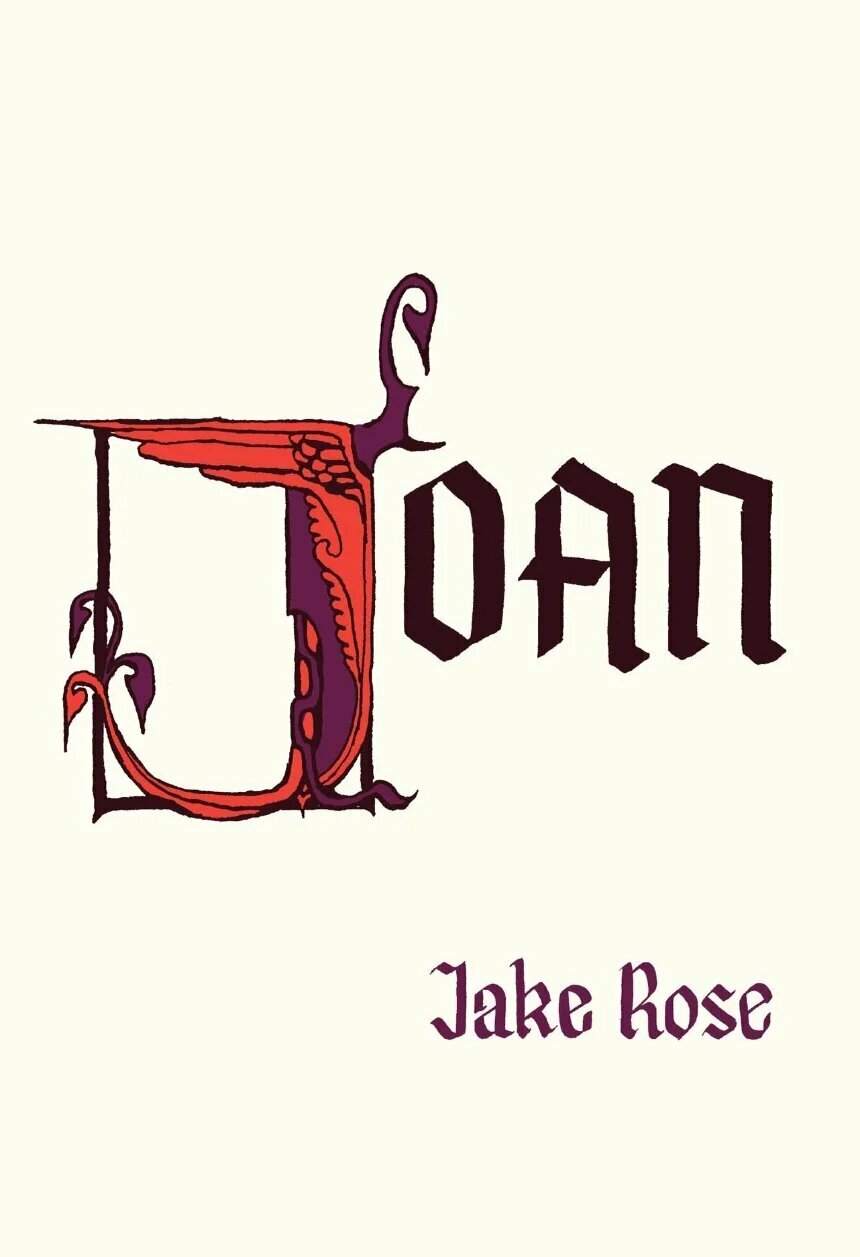
Catherine Niu: I remember in the early days of this project, you told me you'd designed a sort of ritual by which the book was to be written. We were talking about CA Conrad, Lee Seong Bok, Ariana Reines, Socrates, and at the time you were also working out an idea for a book of centos. I wonder if you might speak to some of the sources of inspiration for this brilliant book and/or to how the project went, ended, began?
Jake Rose: Yes! All of my work is deeply indebted to CA Conrad's model of somatic writing rituals. At the time that I was turning toward poetry, the last real literary work I completed was a play, and going through the collaborative process of writing, casting, and seeing that come to life made me wish I could bring a performative and embodied energy to writing; I just didn't know how. When I discovered CA Conrad's poetry, I found such joy and trust in the poet's body, but also unflinching rigor. In an interview, CA said, "My religion is Poetry, not a religion of kindness and love but one of absolute permission. If poetry doesn’t strip me naked in front of my enemies then nothing will." Another inspiration was Theresa Hak Kyung Cha's Dictee, also a book that can be looked at as ritual or performance, and one that takes as a presumption language's failure, and uses image, notes, list, quotation, translation, handwriting, and ephemera to create meaning through assemblage. And that book begins with an epigraph from Sappho, “May I write words more naked than flesh, stronger than bone, more resilient than sinew, sensitive than nerve.” So again there is this commitment to text constructed as a body, or the body as the site of textual performance. You mention my imaginary book of centos, which lives in my head for now, a collection I'm always thinking about and adding to, of poets' work that I hold dear. As I'm pulling these stray thoughts back together now, I come to Marianne Morris writing, "The body is all I have to go on what is going on in me." I think as a child, and then a teen, I was overwhelmed by bodily sensation, and growing up queer as well, there is an added element of shame, distrust, and concealment. Sensation can be an uncomfortable and deviant guide, but these authors helped me understand that it can also be a way through.
As for the project’s beginning and ending: I wrote the first draft in the spring of 2019 when I was living in an attic apartment above a hair salon called To Dye For. I would write zines and chapbooks, designing and printing them at a local copy store, and give them to friends. I did the same with JOAN, and many people still have those first draft versions, which I’m slightly embarrassed by! Then I kept the book on my shelf for the next five years, hoping to revise it someday. In that time, many things in my life changed. I moved from the East Coast to the West, started and finished an MFA, and developed a life-changing chronic illness that I had not fully recognized even as it was emerging. At a very low point, I decided that if I could only accomplish one more thing, it would be to publish a book of poetry, and that would mean turning back to JOAN. That decision is where the book truly began.
CN: I wonder if ritual and routine are powerful in part because they establish a different sort of waterline in our lives, a steady state from which we can then break in new ways. How does ritual inform or show up in your writing practice? In JOAN?
JR: I don't think I could write without ritual, because writing doesn't come naturally to me. If I don't create a ritual and write toward a book, then I don't write at all. Some basic process rituals inform my practice, like always writing with the computer screen dimmed to black, writing for weeks at a time without looking over the work, to generate pages and pages of full margin text. Then I can go back, look for poems within, and it feels like a collaboration, like found text. It also allows for moments of misspelling, misunderstanding, discovery, and fragments to remain preserved. Then there are true rituals that structure each project; for instance, during JOAN I created an altar of images and candles which I lit during each writing, and also bought a box of push-button lancets, so I could, in a sterile fashion, draw blood, then swab it onto tiny paper squares which I cut and collected. I constructed a small wooden box with a slot cut into the top, where I could deposit the paper squares, and mounted it to the wall of the room where I write. I think being raised in a very religious household still leaves me with this feeling of "Take what you want and pay for it, says God." I don't know if I can fully speak to how this process and ritual show up in JOAN, except to say they created the conditions to make the book possible for me.
CN: One of the questions you pose in JOAN is how to identify as beyond human. I remember in a seminar on Henry James, Michael Snediker had framed a similar question and posited a preliminary answer—saying something like, “What if we think of the self as a convergence of winds,” a paraphrase of a line from Peter Richard’s Oubliette: “for now on I’ll serve as the points / upon which various and misguided winds / can agree.”
In JOAN, you write: “how do you identify beyond human / is usually my first question then how would / you choose to be unmade / […] grief is a superpositional / state.”
These ideas of the beyond human (unmaking, superposition) refract searingly through the book. I’m struck by the way JOAN enacts the beyond-human voice, a superpositional state (simultaneously Joan and not-Joan, ancient and contemporary). There is a sincerity and an eroticism throughout the book that marries the sacred and profane, which the book itself addresses in a kind of ars poetica:
“we arrived here as splinters of shade
foraging in the proximity between
the melodic language of dreams and
the nudity of waking speech I don’t think
anything is perverse or unalike on this earth”
I think of Bob Gluck’s 1994 novel Margery Kempe, which weaves the story of the 15th-century mystic Margery Kempe’s devotion to God with the contemporary story of the narrator’s unrequited love. In JOAN there is not a weaving so much as a specific voice speaking very clearly (“I’m not a brat but look at the pitiful state of France”), though the nature of this specificity is a complex one. One complexity is the questioning mode—at once a way of reaching for Socratic truth, an element of intimate dialogue, a punishing interrogation. Can you talk a bit more about the voice or the complexities in this book that drew your interest?
JR: What a wonderful question; let me see if I can address these threads. Unmaking, superposition, and the beyond-human cannot be disentangled, as they are real fears and desires coextensive with one another, central to the experience of the speaker in the book. To me, they are the result of what Akilah Oliver might call "Eros...as derived from chaos...eros as the drive to exhaust the limit of one's own faith...eros as the dream of the earth and its discontent..." Although this desire comes from a primal and chaotic place, it's interested in exploring the world through making distinctions, learning-as-you-go, and it's very sincere, as you said. And the eros that orders the chaotic world is inextricably tied to the earth and material existence. I think the speaker feels both the joy of this coextensive body and the fear of changeability, loss of selfhood. This is where the questioning and self-interrogation become necessary, in fact, to constitute the self. There is a rush to speak, to create and sustain one's being.
CN: JOAN has both the dramatic structure of a narrative work and retains the timeless suspension of the lyric. It is a book in four sections: the first covers a time period of thirty-six months in four pages; the second, five months in seven pages; the third, ten months in thirty pages; the fourth, twelve months in thirty pages. The third section, then, is the most weighty, in terms of the amount of narrative material brought to the page, and it also ends with the longest (swiftest) lines of the whole book. This feels, in a way, like narrative climactic build and release reflected in poetic craft, and I’m curious how you think about narrative, pacing, velocity?
JR: I love story, and I feel deep connection to the propulsive force and organizing principles of narrative— I'm not sure I could write poetry if I didn't consider it narrative, or context within narrative, fragmented, or antinarrative. Because there is an equal and opposing force as well, a terror at narrative's power to summarize, silence, value focus over periphery, and not allow lyric to grow naturally, in a mycelial fashion. I think the narrative in this book tries to strike some balance. I thought of Jackie Wang's line." Nothing is corrected though there is a reckoning". That's the narrative which feels natural to me, an accumulation of experience moving however haphazardly towards a moment of convergence, whatever that may be. The sections are delineated by time, as you mentioned, but how we perceive time changes depending on the intensity of emotion, grief, trauma, joy, and discovery, and I see these things as the organizing principles of narrative in the book as well.
CN: Earlier drafts of this book contain a similar structural and conceptual frame as the published book, though many of the earlier poems have significantly changed at the line level. What were you interested in achieving in revision?
JR: In the first draft, my own life wasn't very present in the book; it felt like a biography of Joan of Arc, although maybe a strange one. In revision, I realized what drew me to Joan, and began the process of blurring biography and autobiography in the poems. I was able to find, during her interrogations, a language that I view as fundamentally queer in its desire to remain restless and resourceful, difficult to name. The historian Karen Sullivan writes that Joan’s speech includes registers that should not coexist, slipping between masculine and feminine, sacred and secular, aristocratic and plebeian. That instability feels queer to me, because it mirrors the way many of us learn to speak from inside lives that don’t quite fit the available language, so speech is a constant and necessary act of invention. I know people may read this book and still see it as just a reimagining of Joan, but importantly for me it is deeply rooted in my own life and experience, and there are so many lines, and some poems, that are written directly from my perspective, to create this shared voice. The writing process was not just rethinking how to present a historical figure; it was a process of self-discovery. After revising, only three or four poems from the first draft are still in the book today.
CN: The book, both continuous (an epic poem) and fragmented (enjambments crop up like wildflowers), takes the bounds of the material page seriously as an element of its rhythm. It’s largely comprised of one-page free verse poems. This rhythm of silences lends a rhythmic, incantatory quality to the book.
“we switch being under one another
and a stain on your shirt distracts me
a little bloodspot of morse code stutter
like the beginning of a poem I could finish
as we lay here in bed turning like fishes
believing was easy what came after that
was difficult when you ask me what happens
when we die I say I don’t know how to
be more truthful in less fragments”
And rhythm is necessarily reliant on the fragment, a discontinuity, what Harold Bloom in The Anxiety of Influence notes as a kind of freedom, the space to “swerve” or deviate. I was especially struck by how the ends of the pages seem to ramp or lift off with a particular intensity (e.g. “let us / first exchange our razored tears I will cut them / from your face and you will cut them from mine”). How do you think about poetic intensity, where it comes from, and/or how your work engages it?
JR: Poetic intensity may emerge from the rhythm that you're describing. As someone who first noticed poetry because of its musicality, the rhythm is almost like the poem's first and final test. These musical elements also represent an alternate way of knowing or performing knowledge, that is coequal with language. I think part of the intensity lies there, the belief and desire within the elements beyond language to communicate just as urgently as within language. Deviating becomes a new vocabulary, and the ends of poems in this book are especially tense because there is a sense of precariousness in not knowing how the possibility to speak may be at any time curtailed or simply revoked. There isn't a comforting sense of dactylic hexameter & epic scale. The speaker is hemmed in by the voices of angels, bureaucrats, and her interrogators alike, so an already constricted space for the voice narrows, and as you said, finding any space to "swerve" through fragment or discontinuity, or to find familiar rhythm, becomes an expression of freedom. However brief. ◆


